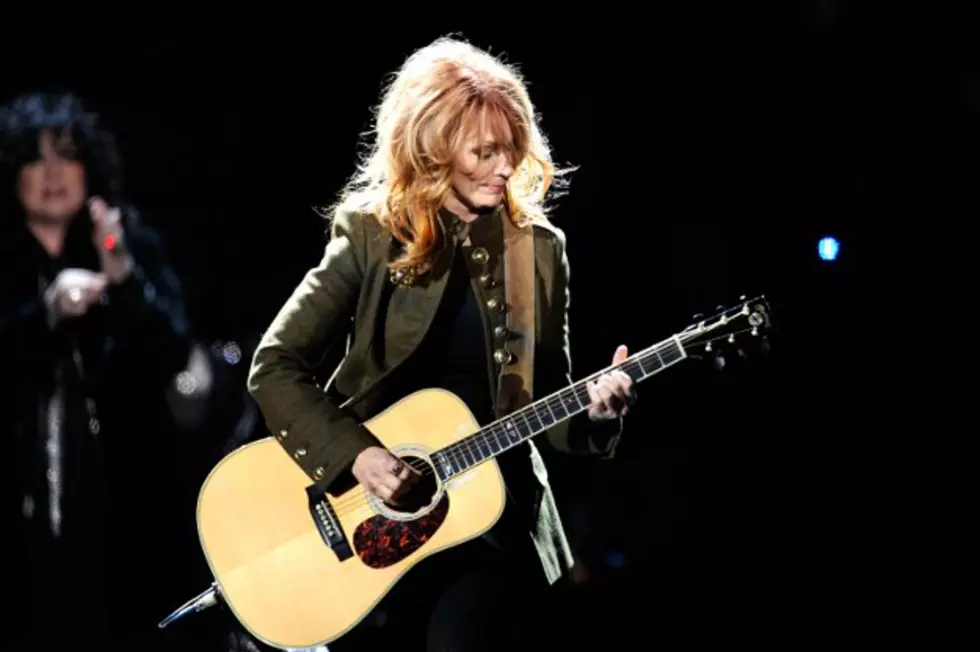
Heart’s Nancy Wilson Discusses ‘Kicking & Dreaming’ Their Way To Rock & Roll Success
In 1975, Heart opened the first of two shows for Rod Stewart in front of a sold-out crowd, which unbeknownst to Ann and Nancy Wilson, had rabidly been anticipating their arrival onstage, thanks to early airplay of their ‘Dreamboat Annie’ album that had been released in Canada earlier that year (prior to being released in the U.S. the following year). Only four days before that, they had been fired from a dispiriting club engagement and left wondering what their next move would be.
The experience of opening those Rod Stewart shows would be a pivotal moment, marking the turning point of what has blossomed into an amazing career for Heart that now has stretched across four decades of success.
In recent years, they’ve been rewarded with a series of accolades for their accomplishments, including a star on the Hollywood Walk of Fame and a long overdue nomination for the Rock and Roll Hall of Fame.
The story of the Stewart gigs is just one of many interesting anecdotes in ‘Kicking & Dreaming,’ the new memoir from the Wilson sisters that was released earlier this month. The book is proof positive that the band, who some once called “Led Zeppelin with t--s” in those early days, has gotten the last laugh on their critics and detractors who they encountered along the way.
The electrifying new Heart album ‘Fanatic’ (out Oct. 2) is the perfect soundtrack to the above reading material and demonstrates that thirteen albums removed from ‘Dreamboat Annie,’ Heart is most definitely still kicking and will never stop dreaming.
We spoke with Nancy about the new album, their continued success as a group and the obstacles that they had to work past to get there.
‘Walkin’ Good,’ from the new ‘Fanatic’ album is obviously a very personal song for you. Going through a major life change like a divorce, were you writing other songs as part of the process as you started moving forward?
Actually, when we were working on ‘Red Velvet Car,’ that was more of the “heartbreak” album for me. I was kind of going through the divorce at that time and trying to come to grips with the separation and the divorce and all of that. So ‘Hey You’ on ‘Red Velvet Car’ was more the song that sort of chronicled the emotional story from being somebody in a “together” relationship to, by the end of the song, somebody who said “hey what happened?”
In the case of “Walkin’ Good’ on ‘Fanatic,’ there was something else going on at the time, a little bit later, when I was starting to understand that I was able to fall in love again. So that’s sort of the recovery idea, you know, it’s like, “Well, I’m not looking back anymore!” I’m not trying to fix the past any longer. I’m going to be walking forward on my own and I’m going to be okay with that. Walking into a whole new time of your life where you’re brave enough and recovered enough to even consider a new relationship and even love.
So that’s kind of the story - it took me a long time. It took me four years to get over and so it’s been only very recently, [that] I’ve been able to be “walkin’ good.” So that’s it in a nutshell. Those two songs kind of take it from the worst to the best.
Writing that one, did you hear Sarah McLachlan as being part of it?
Well I knew that we needed some harmony parts for sure on that chorus, because it’s a singy-songy kind of chorus. It was Ben Mink, our producer, who’s from Vancouver like Sarah is, who suggested her, because they’re kind of from the same town. And I said, “Oh, what a great idea,” because her voice is such a gorgeous instrument. She’s such a great person. We played Lilith Fair for her the previous summer. So we said, “Yeah, by all means ask her.” She heard the song and she really identified with it, because she had kids with somebody that she also split up with. So she really recognized the emotional story there. It was so exciting to have her sing on it.
I told Ann this, but I can really hear, listening to some of the material on the last couple of albums, your experience composing for film coming through in the songs.
Oh God, thanks. Ben Mink is also a scoring artist and as two guitar players playing together, I think we both have a similar sensibility of what to leave out. What to leave out is a big deal.
When I spoke with Ann, I mentioned how you don’t take a lot of lead vocals on the songs, but when you do, you really make them count. You’ve had one solo album outside of Heart. Have you ever had the desire to have more of a vocal voice in the group?
Well you know, I’m just one of those guitar players who loves to sing, but I’ve never thought of myself as a lead singer, per se. I just really love singing and harmony singing is my favorite singing. ‘These Dreams’ was sort of a fluke in a way. It was our first number one hit and it was just one of those songs that I could not resist and I fought for the opportunity to be able to do that in our band and then it turned into our first number one song and suddenly there was all of this attention on me as a singer that I wasn’t very comfortable with.
Now, I approach it as a player, so singing is just kind of like gravy for me. It’s the extra fun once in awhile. It’s an extra fun aspect that adds to the dimension of the band. It brings another dimension into the band that I think is good. It’s kind of like in Fleetwood Mac, there’s the occasional [vocal from] Christine Mcvie [in addition to regular vocalists Stevie Nicks and Lindsey Buckingham] that gives you somewhere else to go [that’s] probably a little softer, a little bluesier over here and then [it goes] back to Stevie and I think it helps the band be more multi-dimensional.
That’s one of the things about the new record is that I think that there’s some interesting color and hearing you trade vocals with Ann on ‘’59 Crunch,’ I don’t feel like I’ve heard you do that before in that way and certainly, not a lot. Was that something new for you?
Well, it’s something we wanted to do more of. I said, “I want to sing more harmonies, I want to sing more harmonies,” and it would be really cool to trade off or sing more unison [vocals]. A good example of someone who did that really well was the Beatles, I thought. Because they both had really cool voices [and] they had a different sound altogether when they sang unison. So we intentionally wanted to do more of that style of singing where it switches up a little bit more often. And I think it’s cool, I think it works really well.
Shifting gears, let’s talk about the new Heart book. How did you and Ann know Charles Cross, who helped you put this together?
He’s our local hero rock writer from Seattle and he’s been around on the scene, especially during the Seattle explosion. He knows a lot of people that we know from town and Ann has read all of his books and they’re great. They’re just so well written. He’s not a gratuitously sensational sort of writer, he’s just a real writer. He adds some rich detail and quality to stories that could otherwise be a little shallow and sugary, like “sugar pop,” stuff that just melts and disappears in five minutes.
He has a substantial way of writing and a quality way of writing, so he was a natural fit. We had toyed with the idea of working with other writers before, but nothing felt as natural and as “Seattle” to us as working with Charles. So he came out and we just did a million hours of interviews in various configurations and places. He did all of the hard work and put it all together and figured out what stories and what chronology [worked best]. He did the real homework - all we really had to do is sit around and talk about ourselves! [Laughs]
Were you and Ann the type who kept diaries and that kind of thing over the years?
Well, you know, the real diaries and the journals that we have kept are in the songs. Those are the songs. I wish we’d had more of a journal to go back and look through, because a lot of that stuff is hard to remember. It’s hard to remember back before the last three and a half decades that we were actually doing music the popular way. There was a lot beforehand that we had to recant. And between me and Ann and our sister Lynn, the oldest, we did a pretty good job, you know? But Charles, he’s really the biographer, I mean, it’s our story that we tell in our own words, but I still think of him as the author.
It does seem like it could be a daunting project doing a book like this. You mentioned your sister, but with Charles being there on the scene as well, was he able to help you fill in the gaps on stuff you were a little bit fuzzy on?
Yeah, he’s a rock historian, so he was able to really do a lot of research that helped us put the timeline together. Because so much of it could actually be a blur. And there’s a lot of other parts of it that we sort of would have rather forgotten - some of the emotional hardships that he had to say, “I’m sorry to have to ask you this, but this is part of your story after all.” Some of it’s pretty painful, but we trust him and I think it was well worth it to tell the story on all of the different levels. It’s a rich story.
There are a lot of great stories in this book. One of the ones that I enjoyed was the one about John Mellencamp questioning his place as the opening act on the bill. Did you run up against stuff like that a lot?
Kind of. There were times when it was hard to be taken seriously, because we were women. And we were really leading the band. We were the leaders, the songwriters, the frontpeople and even inside the band, it was hard to be taken seriously, just because of the perception that women can’t lead or do leadership very well, because they’ll be emotional wrecks for some reason, all of the time.
Even inside the band, it was a little tough that way. There was some jealousy when we got all of the attention. There were other people from the outside that were like “oh, come on, you’re just posing - you don’t really play guitar.” It’s like “yeah, yeah, it’s not a prop - I’ve been doing it since I was nine.” There’s just all kinds of those things that we were never expecting, coming out of the era that we came from, the late ‘60s, where everything was possible and we could change the world. We could get rid of war and we could make peace happen. [But then moving] into the ‘80s, where it was like “come on, bigger hair, more makeup, more corsets!,” that was a real shocker for us. But I think with a sense of humor and a dogged Marine Corp ethic, we managed to put a stepping stone right through the generations.
As women in a “men’s business,” were you able to separate stuff that was discriminatory from stuff that was legitimately what bands would do paying dues? Was it pretty easy to see that line?
We sort of had each other to bounce off of and our mom was a really strong woman too, so our family ethic was really a wonderful survival technique, just to pull the wagons into a circle and consult among ourselves and go, “Well, I don’t think that’s cool, that they tried to make us look like lesbian sister lovers, so we’re writing ‘Barracuda’ about it.” So we kind of railed against a lot of that stuff just by nature of being strong inside of our family unit. Had we each been the only girl in a rock band, it would have been much, much tougher. We might not have made it.
You mentioned ‘Barracuda’ and it’s true, you certainly did always let the music do the talking. The views were very much out there in front in the songs.
Yeah! [Laughs] We had our emotional politics going.
You’ve shared the bill and have been in the room with some amazing people. What are your memories of opening for the Rolling Stones?
Oh, when we opened for the Stones, it was so exciting and it was great. Because right after we came off stage, Mick Jagger came in and wanted to meet us. It was like, “Oh my gosh, Mick Jagger” and he just comes in and says “You guys are great, really love your band. You sound great and I really like your albums.” And we’re like, “Oh cool, wow.” He goes, “I wish Keith could come and meet you too. He likes you too, but nobody knows where he is and we’re going on in 30 minutes!” [Laughs] It’s like whoa, Keith’s not even in the building. But Keith managed to show up and they played a great set and it was just one of the stellar moments.
Did you ever get to finally meet Keith?
I did not get to meet Keith! I think he was pretty busy partying. He wasn’t doing as much socializing as Mick Jagger would do. He’s got his own little back rooms going on everywhere.
As a guitar player, I would think that there were a lot of moments where it was cool for you to get a chance to interface with your peers. And someone like Keith certainly would have fallen easily into that category.
Yeah, if there was somebody I’d like to just hang out and jam with, it would be Keith!
Maybe you’ll have that chance. He’s still going!
Oh and he’s still good.
Heart’s ‘All I Wanna Do Is Make Love To You’ was banned in Ireland...
Well, there were a lot of songs that we were encouraged to record that were written by L.A. stable songwriters and a lot of which I think would have been such big hits for a lot of other bands. But by nature of the fact that it was us and it was not a guy singing, it was a girl singing and not only that, it would be Ann Wilson and [the vocalist] has to sell the song. Having been such a songwriter in her own right, Ann was having difficulties interpreting a lot of these lyrics that she didn’t really get behind as a singer.
I think there’s a few of those “really big hit songs” that didn’t really fly for us, because they were kind of force fed to us and Ann’s delivery just didn’t convince, because Ann wasn’t convinced. So there’s a few Diane Warren songs along the way that any band could have done and had huge hits with, but because of Ann’s soulful delivery that she wasn’t able to do and feel like she was behind, I guess you could say, “It’s not what you say, it’s how you say it.” Things could have been different if Ann hadn’t been such an idealist as a singer.
It’s interesting to hear you say that, because there’s a lot of those songs on those albums, whether it’s ‘Brigade’ or whatever, that you might not have written the song, but I still feel like it came through as sounding like it was one of your own songs.
Yeah, thanks. There’s a skill to that, making it your own, even if it’s not exactly your own. We took some liberties and we took some license with a lot of those songs, [like] “This doesn’t really work over here now, does it?” and we kind of retold the songs to fit our style a little bit better and that was a good idea in many cases. Because we’re not your average bear, this band!

More From WWMJ Ellsworth Maine